
How Long Will an Epoxy Floor Last in a Garage?
The honest answer: a properly installed epoxy garage floor should hold up for 15 to 20+ years, and we have systems out there still performing well past that. A poorly installed one can start failing within the first year. The gap between those two numbers isn't luck — it comes down to a handful of specific factors that determine whether a floor is built to last or built to look good in the "after" photo.
Surface Prep Is the Single Biggest Factor
Every long-lasting epoxy floor starts with diamond grinding the concrete to open its pores and create the right surface profile for a true mechanical bond. Skip this step — or substitute a quick acid etch — and the coating is essentially sitting on top of the slab instead of bonded into it. That's the single most common reason a floor that "looked great" starts peeling at 12-18 months instead of lasting two decades.
A Real System vs. a Single Coat
A durable floor is a system: a basecoat for adhesion, a full flake broadcast for texture and hiding wear, and a topcoat for chemical and abrasion resistance. Thin, single-coat DIY applications simply don't have the mil thickness to handle years of hot tires, dropped tools, and de-icing salt — they wear through faster because there's less material there to wear through in the first place.
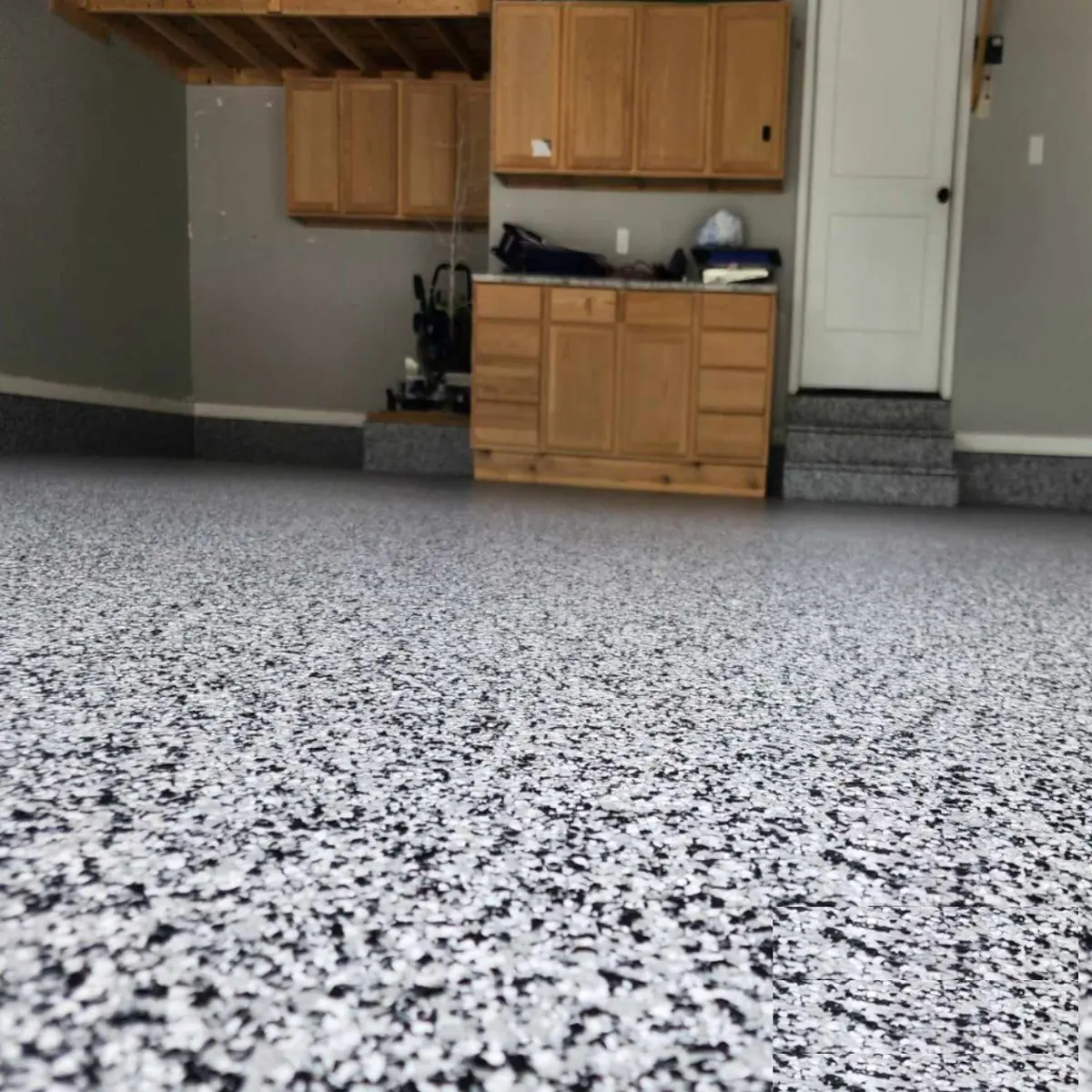
A full broadcast flake system is built to handle daily vehicle traffic for decades, not just look good on install day.
Polyaspartic Topcoat vs. Standard Epoxy Topcoat
The topcoat layer takes the most abuse — foot traffic, tires, chemicals, UV exposure at the garage door. A polyaspartic topcoat is significantly more abrasion- and UV-resistant than a straight epoxy topcoat, and it's what keeps the floor glossy and protected for the long haul instead of dulling and thinning out within a few years.
What Actually Wears a Floor Out Faster
Even a properly installed floor has enemies: unpadded jack stands or tool chest legs concentrating weight on tiny points, dragging heavy metal across the surface instead of lifting it, harsh solvents left to sit instead of being wiped up, and de-icing salt tracked in and left to dry rather than rinsed off. None of these will destroy a quality system overnight, but they add up faster than normal wear and tear does.
How Climate and Usage Affect Lifespan
Mid-Missouri's freeze-thaw winters and hot summers put real stress on a garage floor — temperature swings, road salt, and moisture cycling. A properly prepped and coated system is built to handle that; it's actually one of the reasons epoxy holds up better here than sealed or unsealed bare concrete, which pits and spalls under the same conditions. Heavy daily use (a working shop, multiple vehicles, equipment storage) will naturally show wear sooner than a floor that mostly parks one car — but "sooner" for a quality system still typically means well over a decade before a refresh topcoat is worth considering.
Signs Your Floor Is Reaching End of Life (vs. Just Needing a Refresh)
A dulling topcoat after 10-15 years of heavy use isn't failure — it's normal, and often a fresh topcoat restores the shine without redoing the whole system. Actual failure looks different: peeling, bubbling, or delamination, which is a bonding problem, not a wear problem, and usually means the original prep was insufficient. Knowing the difference matters, because one is a maintenance refresh and the other is a full redo.
The Bottom Line
15-20+ years is a realistic expectation for a properly diamond-ground, full-system, polyaspartic-topped epoxy floor. The floors that don't make it that far almost always skipped a step somewhere in prep or materials — which is exactly why it's worth asking a contractor directly what their grinding, coat count, and topcoat process actually looks like before you hire them.
If you would rather pay once than recoat every few years, see the cost of a long-lasting floor for your square footage.
Frequently Asked Questions
How many years does an epoxy garage floor last?
A properly installed epoxy garage floor — diamond-ground slab, full basecoat/flake/topcoat system, polyaspartic topcoat — typically lasts 15 to 20+ years before needing a refresh. Poorly installed floors can fail within 1-2 years.
What shortens the lifespan of an epoxy floor the most?
Skipped or inadequate surface preparation is the single biggest factor, since it determines whether the coating actually bonds to the concrete or just sits on top of it. Thin single-coat applications and standard (non-polyaspartic) topcoats also wear out faster.
Does an epoxy garage floor need to be redone after a certain number of years?
Not necessarily a full redo — a dulling topcoat after a decade or more of heavy use can often be refreshed with a new topcoat rather than a complete strip and recoat. A full redo is only needed if the underlying bond has failed, which shows up as peeling or bubbling.
Does climate affect how long an epoxy floor lasts?
Yes, but a properly installed system is built to handle freeze-thaw cycles, road salt, and temperature swings — in fact, epoxy typically outlasts bare or sealed concrete under the same conditions, since bare concrete is more prone to pitting and salt damage over time.
Related Articles
Want a Floor That Lasts Decades, Not Months?
Get a free evaluation and see what a properly installed system actually looks like for your garage.
Get My Free Evaluation →