
How Many Coats of Epoxy Do I Need on My Garage Floor?
Most garage floors need three layers, not one. When people ask how many coats of epoxy a garage floor needs, they're usually picturing something like painting a wall — one coat, maybe two, done. A real epoxy flooring system doesn't work that way. At Show Me Epoxy, a standard install is a basecoat, a full flake broadcast, and a protective topcoat — three distinct layers that each do a different job.
Understanding what each layer actually does explains why hardware-store kits that promise "one easy coat" almost never hold up, and why a professional install takes a full day even though the actual coating only takes a few hours to apply.
The Three Layers of a Real Epoxy System
1. The Basecoat
The basecoat is the layer that actually bonds to the concrete. It's applied directly onto the diamond-ground slab and soaks into the surface profile the grinding created. This is the layer doing the structural work — if it doesn't bond properly, nothing applied on top of it matters. The basecoat also gives the floor its base color before flake or topcoat go down.
2. The Flake Broadcast
While the basecoat is still wet, decorative vinyl flake is broadcast across the entire surface — not sprinkled lightly, but fully covered edge to edge in a proper full-broadcast system. This layer does more than add color and texture. It adds real thickness and durability to the floor, and it's part of why a flake system floor feels different underfoot than a bare solid-color coating.
3. The Topcoat
After the flake cures, the floor is scraped smooth and vacuumed, then sealed with a clear protective topcoat — usually polyaspartic for faster cure times and better UV stability. This is the layer that takes the daily abuse: hot tires, dropped tools, chemical spills, foot traffic. Without it, the flake and basecoat underneath would wear away much faster.
Three layers, three different jobs. Skip one, and the floor is missing a piece of what makes it durable.
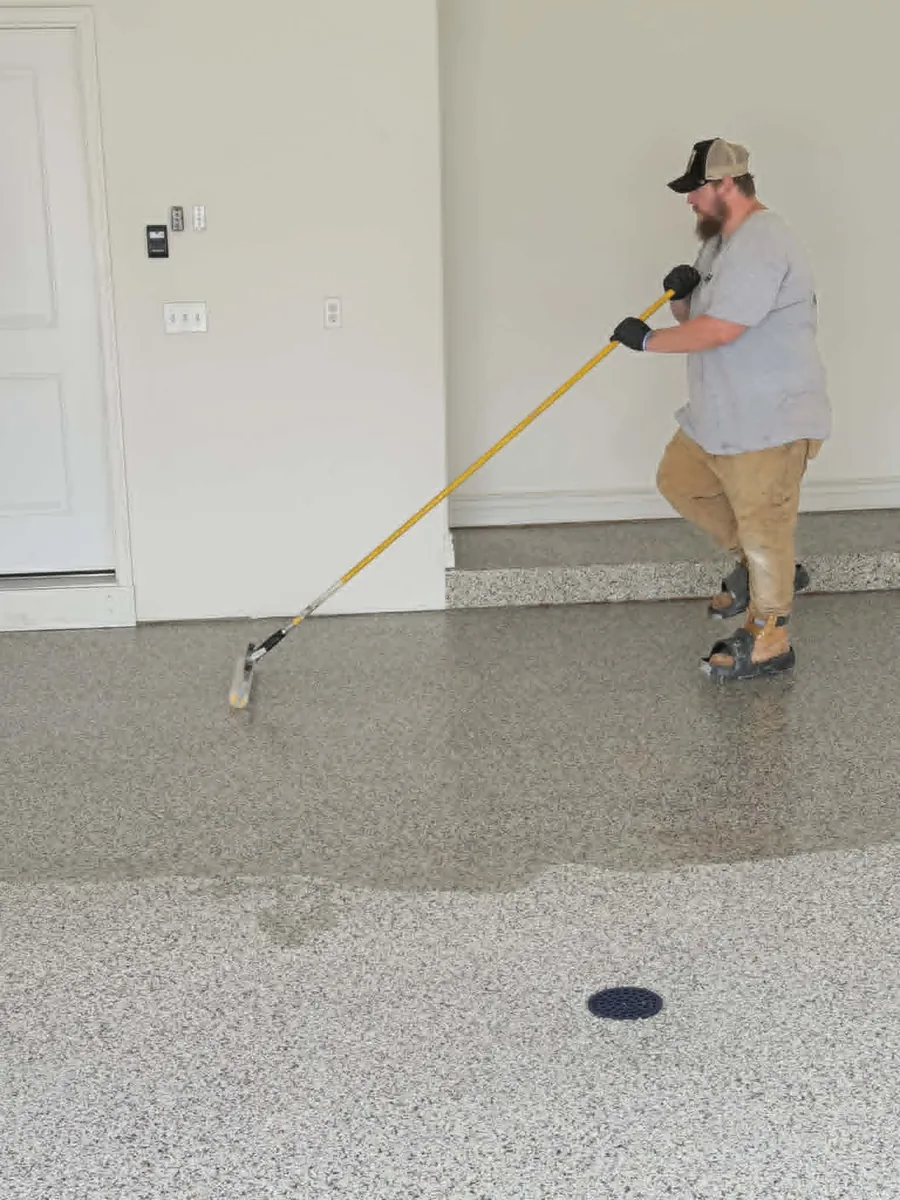
Applying the final topcoat layer — the protective seal over the basecoat and flake underneath.
Why "One Coat" DIY Kits Fall Short
Most hardware-store epoxy kits are built around simplicity: one or two coats, applied quickly, with a light flake sprinkle that's more decorative than functional. That's not necessarily dishonest — it's just a different, thinner product built for a weekend project rather than a floor meant to last a decade or more.
The bigger issue usually isn't even the number of coats. It's what's underneath them. A DIY kit applied over acid-etched concrete, without mechanical grinding, won't bond as well regardless of how many coats go on top. More coats of a coating that isn't bonded to the slab just means more material that eventually peels together.
Does More Coats Always Mean a Better Floor?
Not necessarily — but there are legitimate reasons a floor might get an additional layer:
- High-traffic commercial spaces sometimes get a second topcoat for extra wear resistance
- Workshop or shop floors with heavy tool use or chemical exposure may benefit from added topcoat thickness
- Uneven substrates occasionally need an extra leveling pass with basecoat material before flake goes down
For a standard residential garage, though, a properly applied three-layer system — basecoat, full broadcast flake, topcoat — is the complete, correctly engineered system. Adding more layers on top of a properly prepared, properly applied system doesn't make it dramatically more durable; it's the prep and the bond that matter most, which is why diamond grinding gets so much attention in how we talk about installs.
How Long Does Each Layer Take to Cure?
Timing between layers matters as much as the layers themselves. After the basecoat and flake broadcast, the floor typically needs a few hours before it can be scraped and vacuumed. The topcoat is usually applied the same day once that's done. From there, walk time is typically around 24 hours and drive time around 48 hours, though this varies by product and weather — see our full breakdown in how long epoxy installation takes.
Curious what a full three-layer flake system would look like in your garage? Preview our 27 real flake blends on a garage floor, or upload a photo of your own space. When you find one you like, carry it straight into an instant estimate.
The Bottom Line
If someone tells you their epoxy floor is "one coat," ask what's actually in that coat — a real system still needs a bonding basecoat and a protective topcoat around whatever decorative layer is used, even if it's marketed as a single product. The number of layers matters less than whether each layer is doing its job on a properly prepared slab.
Frequently Asked Questions
How many coats of epoxy does a garage floor need?
A standard professional installation uses three layers: a basecoat that bonds to the concrete, a full flake broadcast for texture and durability, and a protective topcoat that seals the system. Each layer serves a different purpose, and skipping one weakens the whole floor.
Is one coat of epoxy enough for a garage floor?
A single coat can work for very light, decorative use, but it won't hold up the way a full basecoat-flake-topcoat system does under hot tires, tools, and daily traffic. Most one-coat DIY kits are built for a lighter-duty result than a full broadcast professional system.
What's the difference between basecoat and topcoat?
The basecoat is the layer that bonds directly to the ground concrete and holds the flake in place. The topcoat is the clear protective layer applied last, which is what actually takes the wear from tires, tools, and foot traffic.
Can you add extra topcoats for more durability?
Yes — high-traffic commercial floors or heavy-use shop spaces sometimes get a second topcoat for added wear resistance. For a standard residential garage, one properly applied topcoat over a full broadcast system is typically sufficient.
How many layers does an epoxy garage floor have?
Three, not two: a basecoat, a full flake broadcast, and a topcoat. It's a common mix-up to ask whether epoxy just needs "two coats" — in a real system, the flake broadcast between the basecoat and topcoat is what gives the floor its texture and most of its durability, so it isn't optional.
Related Articles
Want a Floor Built in Full Layers, Not Shortcuts?
Every Show Me Epoxy install gets the full basecoat, broadcast, and topcoat system — never a single coat pretending to be a floor.
Get My Free Quote →