
Cost & Pricing
6 questionsIn Missouri, professional epoxy garage floor installation cost depends on the condition of your concrete, the prep required, the system chosen, and your square footage — so the real answer is different for every garage. The fastest way to get a straight answer is our Instant Price Calculator: enter your garage size and system, and get a real ballpark in under a minute. We also publish a local cost breakdown for every area we serve — see our cost guides by area.
Several variables influence the final price of your epoxy floor project:
- Concrete condition: Cracks, spalling, moisture issues, or old coatings require more prep time and materials
- Square footage: Larger floors cost more in total but often less per square foot
- System chosen: Polyaspartic systems cost more than standard epoxy; metallic and decorative systems cost more than solid color
- Number of coats: A base coat + broadcast flake + topcoat system costs more than a single-coat application
- Color and flake density: Full broadcast flake coverage costs more than partial broadcast
- Access and layout: Obstacles like vehicles, shelving, or irregular shapes add time
For most homeowners, yes — especially for garage and basement floors. Here's why the math tends to work in your favor:
- A properly installed epoxy floor lasts 10–20+ years with minimal maintenance
- It protects your concrete from oil stains, chemical damage, and moisture
- It increases your home's appeal and resale value
- It's dramatically easier to clean than raw concrete
Compare this to repainting every 2–3 years, or dealing with dusty, stained concrete indefinitely — and the value proposition is clear for most homeowners.
10-20+ years is a typical service life for a properly installed system, not a written warranty length — ask about our specific warranty terms at your free quote.
On paper, yes — a DIY kit costs less upfront than professional installation. But there's an important catch: DIY kits almost always fail within 1–3 years because they're designed for acid-etched concrete rather than diamond-ground concrete. Acid etching creates a much weaker bond than mechanical grinding. Use our Instant Price Calculator to see what professional installation actually runs for your space before you decide.
When a DIY floor fails, you'll often need to pay a professional to remove the old coating before re-coating — which is expensive. Many of our customers come to us after a failed DIY attempt that cost them more in the end.
Yes — completely free, and we mean no-pressure. You can get an instant online estimate using our free quote form, or call us at (573) 644-2422 to schedule a free in-person walkthrough.
During the walkthrough, we'll assess your concrete condition, discuss what system makes the most sense for your goals, and give you a clear, itemized price — no vague ranges, no surprise add-ons after you sign.
Surface Preparation
5 questionsDiamond grinding is the process of mechanically abrading the concrete surface with diamond-tipped blades before applying any coating. It does two things: opens the pores of the concrete so the epoxy can penetrate and bond deeply, and removes any surface contamination that would prevent adhesion.
This creates a mechanical bond — the coating physically locks into the slab — rather than just sitting on top. Without it, even the best epoxy will eventually delaminate under hot tires, heavy loads, or freeze-thaw cycles.
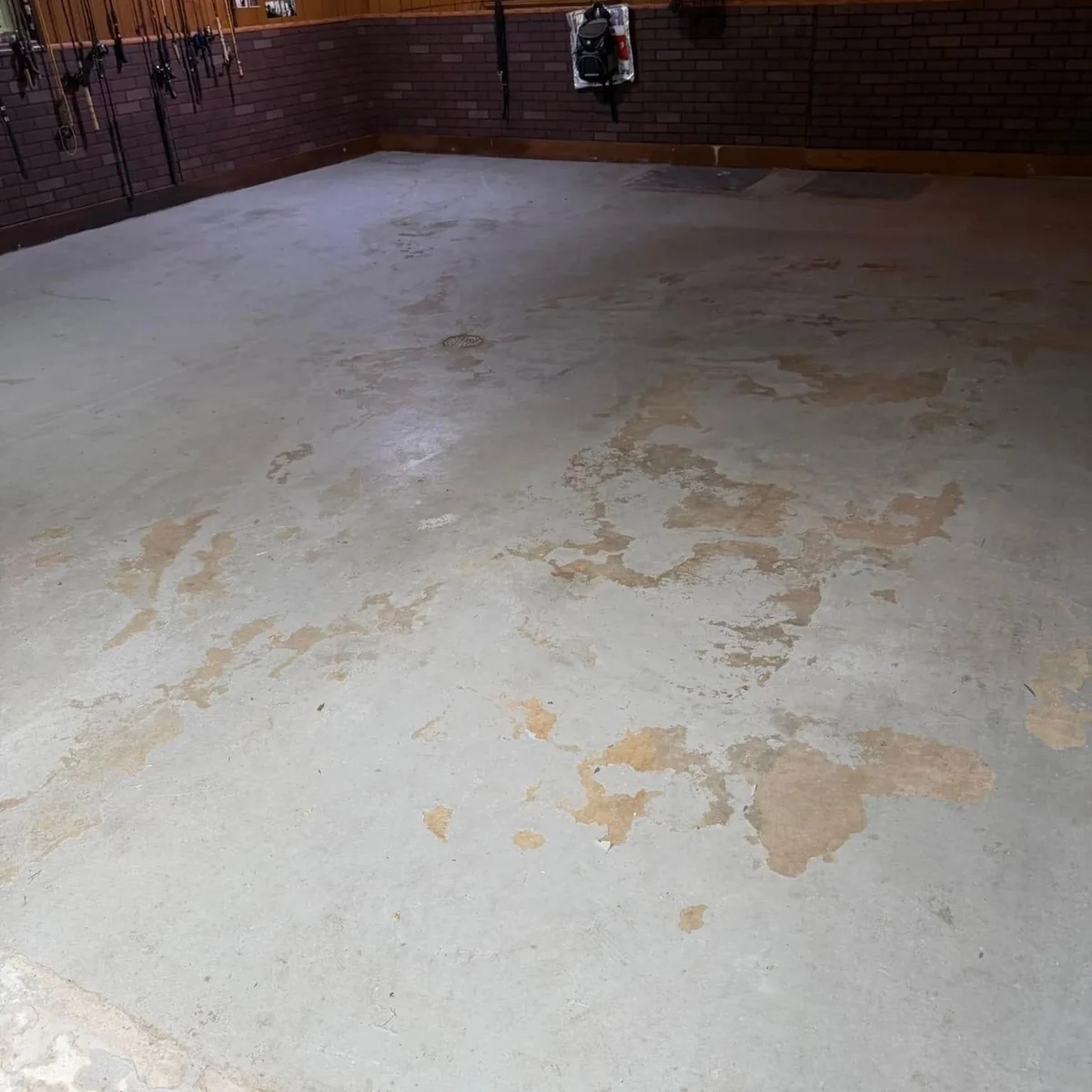
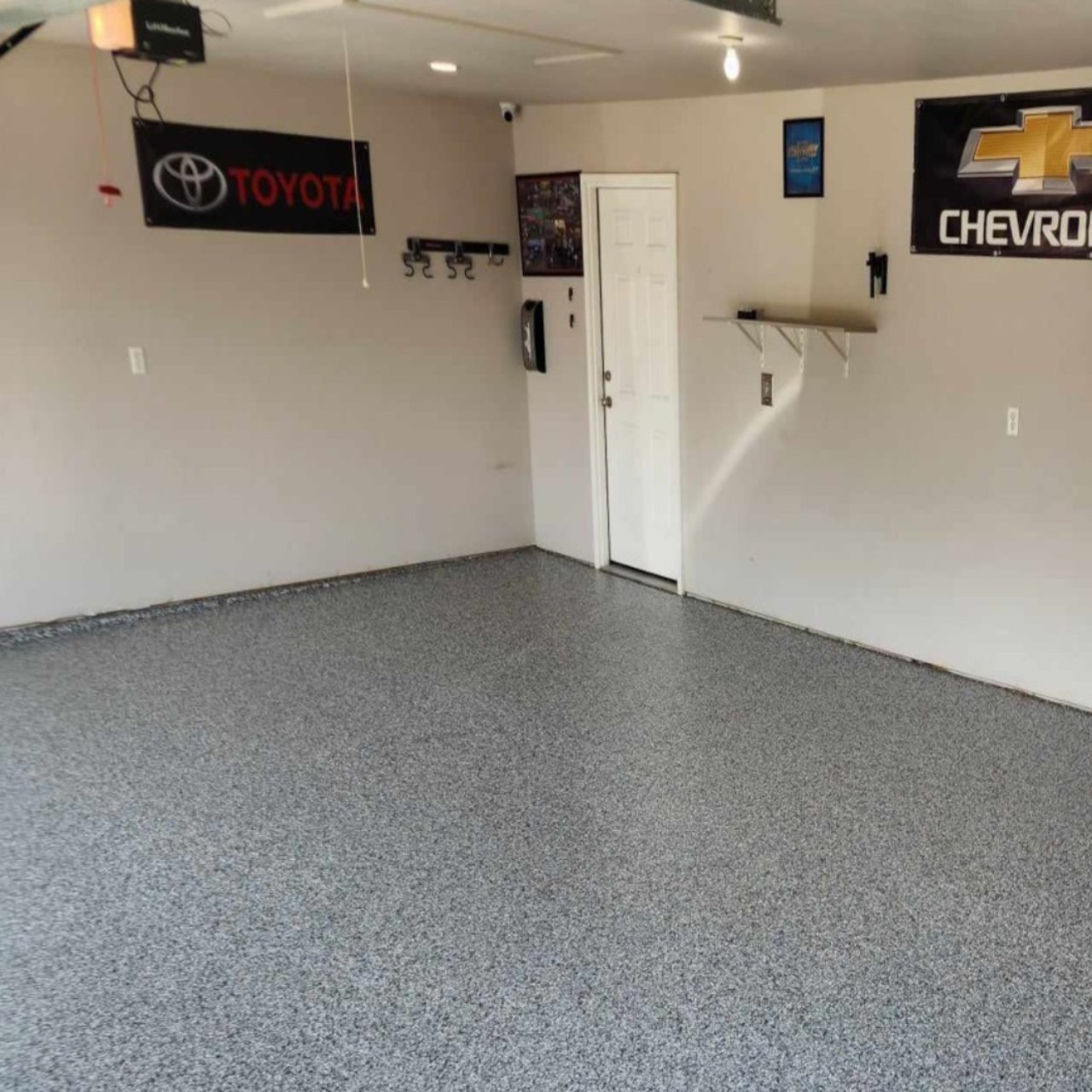
Yes — cracks should be repaired before coating, and we do this as part of our process. We use polyurea or epoxy crack fillers to repair surface cracks, divots, and spalled areas.
For dormant cracks (not actively moving): we fill, grind flush, and coat over them — the repaired area will be nearly invisible in the finished floor.
For active cracks (still moving due to settling or heaving): we'll discuss your options during the consultation. Some active cracks can be addressed with flexible crack repair; others may need a different approach.
In most cases, yes. Oil-contaminated concrete needs more aggressive prep — diamond grinding removes surface contamination, and we use degreasers on heavy stains before grinding. The goal is to reach clean, uncontaminated concrete before applying any coating.
Very old, deep oil contamination (in concrete that's been a shop floor for decades, for example) can sometimes penetrate too deeply to fully remediate. We'll assess this during your walkthrough and be upfront if we see potential adhesion concerns.
Moisture is one of the most common causes of epoxy failure. If moisture vapor is pushing up through the slab (a condition called MVE — moisture vapor emission), standard epoxy can blister, bubble, or delaminate.
We test moisture levels before every install and can recommend moisture-tolerant systems — including specific epoxy formulations and vapor barriers — when needed. This is especially relevant for basement floors and ground-level garage slabs in areas with high water tables.
It depends on the condition and adhesion of the existing coating. If the existing coating is well-bonded and in good condition, we can sometimes grind it and apply a new system over it. If it's peeling, bubbling, or poorly adhered, it needs to come off first — otherwise your new floor is only as strong as the weakest layer underneath.
We'll assess the existing coating during your walkthrough. Removal adds time and cost but is always the right call when the old coating is failing.
Still have questions? Let's talk.
We walk every customer through exactly what their floor needs — no pressure, no jargon. Call us or get a free quote online in 60 seconds.
Materials & Floor Types
5 questionsBoth are high-performance coating systems, but with different characteristics:
- Epoxy: Longer cure time (24–72 hrs), excellent adhesion, more affordable, slight yellowing possible in UV-exposed areas
- Polyaspartic: Much faster cure (sometimes hours), UV-stable (no yellowing), handles temperature extremes better, higher cost
Many professional installations combine both — epoxy as the base coat for maximum bond strength, polyaspartic as the topcoat for durability, UV stability, and fast cure. This is the system we recommend for most garage floors.
A flake system (also called a chip or broadcast system) involves broadcasting vinyl color flakes onto the wet base coat before applying the topcoat. The result is a speckled, granite-like appearance that hides dirt and imperfections well and adds texture for slip resistance.
We offer a wide range of flake blends — from subtle earth tones to bold contrasting mixes. We'll bring physical samples to your consultation so you can see how they look in your actual space with your lighting. Colors look different on a 4"x4" sample card than they do across 500 square feet of floor.
Metallic epoxy uses metallic powder pigments mixed into the epoxy base coat to create a flowing, iridescent, almost liquid-stone appearance. No two metallic floors are exactly alike — the installation technique creates unique swirls and patterns.
It's a striking option for showrooms, high-end garages, basements, and interior spaces. It's more expensive than a standard flake system and requires skilled application. For pure functionality in a working garage, a flake system is often more practical. But if aesthetics are the priority, metallic floors are stunning.
A smooth, high-gloss epoxy floor can be slippery when wet, similar to polished concrete. However, all of our installations include slip-resistant options:
- Full-broadcast flake systems naturally add texture and grip
- Anti-slip additives (like aluminum oxide or silica sand) can be mixed into the topcoat for additional traction
For outdoor patios, pool decks, and commercial spaces where wet conditions are common, we always recommend a textured finish.
This is one of several honest tradeoffs worth knowing before you commit — see our full rundown of epoxy's real downsides.
Epoxy countertops are a durable, customizable option for kitchens, bathrooms, and workshop spaces. Key things to know:
- They're heat resistant to a degree, but not as much as stone — always use trivets for hot pans
- They're stain-resistant when properly sealed
- UV-stable formulations are important for kitchens near windows to prevent yellowing
- The design possibilities are nearly unlimited — solid colors, swirled patterns, geode effects
We offer custom epoxy countertop installations for kitchens, bathrooms, laundry rooms, bars, and custom spaces.
The Installation Process
6 questionsFor a standard 2-car garage with a polyaspartic system, installation typically takes one full day. Standard epoxy systems may require two days — one for the base coat and one for the topcoat after adequate cure time.
Larger floors, extensive crack repair, or removing existing coatings add time. We'll give you a specific timeline during your consultation based on your actual floor.
Timing depends on the system used:
- Standard epoxy: Walk on in 24 hours, drive on in 48–72 hours
- Polyaspartic: Walk on in as little as 6–12 hours, drive on in 24 hours
Temperature affects cure time — warmer temperatures speed things up, cooler temperatures slow them down. We'll give you specific guidance based on the system installed and the weather conditions on the day of your install.
You don't have to leave, but you should keep the work area well-ventilated and avoid it during application. There are odors involved — especially with the base coat — that require good airflow.
For garage floors: you can stay in your home and simply keep the door between the garage and living space closed and well-sealed during the work. For basement and interior installations, we recommend ensuring good cross-ventilation and spending time in other parts of the home or outside during application.
Standard epoxy requires a minimum concrete temperature of around 50°F (10°C) for proper curing. Below this, the chemical reaction that hardens the epoxy slows significantly or fails — resulting in bubbling, delamination, or a coating that never fully cures.
In Missouri, this affects late fall through early spring installs. For cold-weather projects, we may recommend polyaspartic systems (better low-temperature performance), or scheduling your install during a warmer stretch. We won't install in conditions that risk the quality of your floor.
To make installation day go smoothly:
- Clear the space completely — remove vehicles, equipment, shelving, and all items off the floor
- If there are heavy shelving units bolted to the wall, we can discuss working around them or they can be temporarily moved
- Ensure we have access to a power outlet (we bring our own extension cords)
- If doing a basement, ensure windows or doors can be opened for ventilation
We'll confirm everything specific to your space ahead of time. We handle all the grinding, prep, and cleanup — you just need to clear the floor.
Diamond grinding produces concrete dust, which is why we use industrial vacuums with HEPA filters attached directly to the grinder — capturing the vast majority of dust at the source. The space stays much cleaner than you might expect.
We clean up thoroughly at the end of each day. You shouldn't be left with concrete dust throughout your home or garage. Many of our customers are surprised at how tidy the process is.
Maintenance & Care
4 questionsEpoxy floors are one of the easiest surfaces to maintain. Here's the routine:
- Daily: Sweep or dust mop to remove grit (abrasive particles are the main enemy of floor gloss)
- Weekly/as needed: Mop with a mild, pH-neutral cleaner diluted in warm water
- Spills: Wipe up promptly, especially chemicals — epoxy is resistant but not impervious to prolonged chemical exposure
- Avoid: Citrus-based or vinegar cleaners, steel wool, or abrasive scrubbing pads — these can dull the finish over time
Light surface scratches are usually not visible on flake systems because the texture disguises them. On solid-color or metallic floors, light scratches may be more noticeable but can often be buffed out.
For deeper gouges or damage, spot repairs are possible in most cases. Give us a call — we can assess whether a localized repair is feasible or whether the topcoat needs to be recoated in that area.
With proper installation (diamond grinding + quality materials) and basic maintenance, you can expect:
- Garage floors: 10–20+ years
- Basement floors (low traffic): 15–25+ years
- Commercial/industrial floors (heavy traffic): 5–15 years depending on use intensity
The number-one factor in longevity is the quality of prep. Floors installed on properly ground concrete with industrial-grade materials outlast DIY or acid-etched installs by many years.
These are typical expected service life ranges, separate from our written warranty — ask about the specific warranty terms for your project at your free quote.
For a full breakdown of what determines lifespan, read how long an epoxy garage floor actually lasts.
"Hot tire pickup" is one of the most common complaints about failed epoxy floors — the tire gets hot while driving, then as it cools in the garage, it bonds slightly to the floor surface and tears up the coating when you pull out.
This almost always happens with improperly installed or DIY floors that used acid etching instead of diamond grinding, or that used a floor paint rather than a true epoxy system. Our installations use properly ground concrete and polyaspartic topcoats that are specifically formulated to resist hot tire pickup.
Missouri-Specific Questions
4 questionsMid-Missouri's climate presents a few specific considerations for epoxy floors:
- Freeze-thaw cycles: Concrete expands and contracts with temperature swings. A properly bonded floor handles this; a poorly bonded one can crack or delaminate along with the concrete movement.
- Humidity in summer: High ambient humidity during installation can affect adhesion and cure quality. We monitor conditions and can adjust timing or product selection accordingly.
- Road salt and de-icing chemicals: These are tough on bare concrete but epoxy and polyaspartic systems are highly resistant to salt and chemical de-icers.
We're based in Jefferson City and serve a broad area of Mid-Missouri, including:
- Jefferson City and surrounding communities
- Columbia and Boone County
- Lake of the Ozarks, Osage Beach, and Camdenton
- Rolla and Phelps County
- Fulton, California, Holts Summit, Eldon, and Sedalia
Not sure if we come to your area? Give us a call at (573) 644-2422 — we may be able to accommodate your location even if it's not listed.
Show Me Epoxy has been serving Mid-Missouri homeowners and businesses since our founding in Jefferson City. We're locally owned and operated — not a franchise — which means you deal directly with the people doing your floor.
You can find our reviews on Google by searching "Show Me Epoxy Jefferson City" or visit our reviews page. We're proud of our 5-star rating and genuinely appreciate every customer who takes the time to leave feedback.
Didn't find your answer?
Call us directly — we love talking floors. Or check out our blog for in-depth guides on every epoxy topic.