
What Are the Signs of a Bad Epoxy Floor Job?
Not every epoxy floor that looks fine on installation day stays that way. The most common signs of a bad epoxy floor job are peeling, bubbling, hot tire marks, and blotchy or uneven color — and almost all of them trace back to one root cause: the concrete wasn't properly prepared before the coating went down. At Show Me Epoxy, we get called out to look at failed floors regularly, and the pattern is almost always the same.
Here's what to actually look for, what usually causes it, and how soon these problems tend to show up.
Peeling or Delamination
This is the most obvious sign something went wrong. Peeling means the coating never mechanically bonded to the concrete — it was sitting on top of the slab rather than anchored into it. This almost always traces back to skipped or inadequate surface preparation, most commonly a lack of diamond grinding before the coating was applied. Acid etching alone, or no prep at all, leaves the surface too smooth for a real mechanical bond.
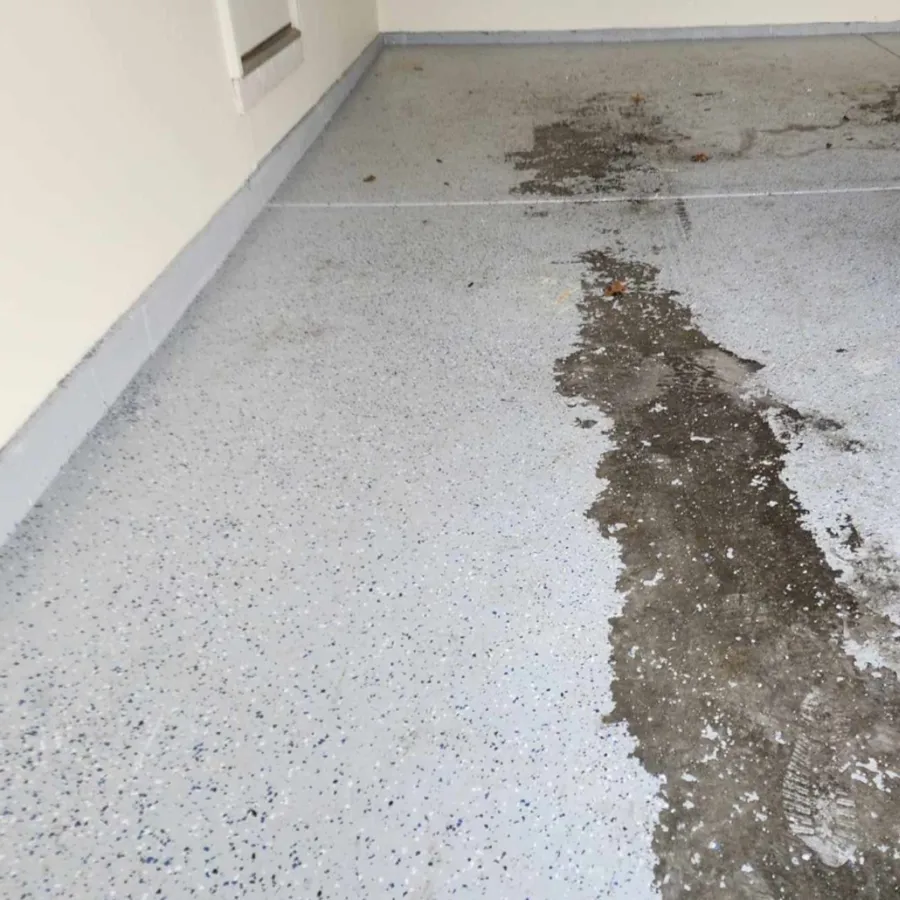
Peeling like this is the clearest sign the coating never bonded to the concrete underneath.
Bubbling
Small bubbles or blisters trapped under the coating usually point to moisture. If moisture vapor was moving up through the slab during or after installation and wasn't addressed beforehand, it can push the coating up from underneath as it tries to escape. This is one of the reasons a proper moisture assessment matters before coating a basement or an older garage slab.
Hot Tire Pickup
This is a specific, very recognizable failure: tire-shaped marks where the coating has softened, wrinkled, or lifted after a vehicle parks on the floor while the tires are still hot from driving. It happens when the coating system wasn't fully cured before use, or when a lower-grade material without enough chemical resistance was used on a floor that needed something more durable. It's also why professional installers give clear guidance on drive time — see our breakdown of how long installation and curing actually take.
Blotchy or Uneven Color
If a solid-color or lightly-broadcast floor looks patchy, streaky, or inconsistent in color and sheen, it's often a sign of uneven application, inconsistent mixing, or coating applied over a surface with inconsistent porosity — which happens when parts of the slab were properly ground and other parts weren't. A full flake broadcast system tends to hide minor application inconsistencies much better than a thin solid-color coat, which is one reason we lean on full broadcast for most garage installs.
A Surface That Stays Tacky
Epoxy and polyaspartic coatings should cure to a hard, non-tacky finish. If a floor still feels sticky or soft days after installation, something went wrong with the mix ratio, the product chemistry, or the temperature conditions during application — cold slabs in particular slow cure time and can cause improper curing.
Flaking or Chipping at Edges and Seams
Edges, corners, and transitions to the driveway are the first places a poorly bonded coating tends to fail, because they take extra stress from foot traffic and vehicle movement. If you see small chips or lifted edges starting along the perimeter of the floor, it's often an early warning sign of a broader bonding problem that will spread.
How Soon Do These Problems Show Up?
Some failures are immediate — bubbling or tackiness that never properly cures shows up within days. Others take longer: peeling from inadequate prep often doesn't show up until the floor has taken real use, sometimes not until the first hot summer or the first winter of road salt exposure. That delayed timeline is exactly why prep quality matters more than how the floor looks on day one — a floor can look great at handoff and still be set up to fail.
What to Do If You're Seeing These Signs
Once a coating starts failing, coating over it again doesn't fix the underlying problem — it just adds another poorly-bonded layer on top. The only real fix is to grind the failing coating off and start over with proper prep. If you're dealing with a floor that's showing any of these signs, an honest evaluation is the right next step before spending more money trying to patch it.
Before paying for the same floor twice, take a minute to compare the cost of professional installation for your square footage.
Frequently Asked Questions
What are the first signs of a failing epoxy floor?
Peeling at the edges, small bubbles trapped under the coating, and a surface that never fully hardens are usually the earliest signs. These typically point back to inadequate surface preparation or moisture issues that weren't addressed before installation.
Why does epoxy peel off a garage floor?
Peeling almost always means the coating never formed a real mechanical bond with the concrete. This usually happens when the slab was acid-etched or not prepped at all instead of being mechanically diamond ground, which is the step that actually opens the concrete pores for the coating to grip.
Is bubbling in epoxy flooring normal?
No. Bubbling usually indicates moisture vapor pushing up through the slab, or air trapped during application. It's not a normal part of curing and typically means the floor needs to be reassessed rather than left alone.
How soon can epoxy floor problems show up after installation?
Some issues, like tackiness or bubbling, show up within days. Others, especially peeling caused by poor prep, may not appear until the floor has been through a season of heavy use, hot tires, or winter road salt — which is why a floor looking fine at handoff isn't a guarantee it was installed correctly.
Related Articles
Already Dealing With a Failing Floor?
We diagnose failed epoxy floors all the time. Get a free evaluation and an honest answer about what it will take to fix it.
Get My Free Evaluation →